Meta and Instagram ad formats in 2026
Every Meta and Instagram ad format that serves in 2026, with exact sizes, safe zones, and what converts at each funnel stage.
The full Google Ads stack in 2026: Performance Max, AI Max for Search, Demand Gen, YouTube CTV. Sizes, funnel mapping, and the Power Pack budget split.
Five things to know if you're skimming:
Now the version you actually run campaigns from.
A few structural shifts have reshaped Google Ads since 2023.
Performance Max accounts for roughly 65% of Google Ads spend in 2026. (Source: Wizard Creative Labs)
Demand Gen replaced Discovery campaigns in 2024 and is now the visual-first upper-funnel campaign type. It runs across YouTube, Gmail, Discover, and Maps.
AI Max for Search exited beta on April 15 2026. It uses generative AI to rewrite headlines and descriptions, expand to keyword-less matching, and route users to the best landing page. (Source: Google Blog)
Demand Gen now serves on Connected TV. Google reports an average 7% more conversions at the same ROI when Demand Gen campaigns include TV screens. (Source: groas.com)
The Google VRC non-skip CTV format went global in 2026. Non-skippable, AI-optimised CTV inventory is now buyable at scale.
The practical implication. An account running only Search and a legacy Display campaign in 2026 is leaving half of Google's inventory unaddressed. We still see plenty of these.
Search is still the highest-intent surface on the internet. AI Max is what Google now calls the modern Search campaign.
What's in the box:
Google reports an average 7% more conversions or conversion value at the same CPA or ROAS using the full AI Max feature suite versus search-term-matching alone. (Source: Google Ads Help)
Asset requirements:
Use AI Max when you have bottom-of-funnel intent to capture. People are searching with intent. AI Max meets them there.
Watch out for brand-term cannibalisation if you let URL expansion run unchecked on multi-product sites. Set negative URL rules.
Google's flagship AI-served campaign. One campaign, all surfaces: Search, Display, YouTube, Discover, Gmail, Maps, Shopping.
What you provide: goals and target CPA or ROAS, asset groups (text, image, video, product feed), audience signals (your guess at who the buyer is, used by the algorithm as a hint not a hard constraint), and budget.
What Google does: mixes and matches assets in real time, decides placement and audience and bid per impression, and optimises continuously toward your conversion goal.
Asset requirements per asset group:
Use PMax when you want full-funnel cross-channel coverage with one campaign, you have conversion data the algorithm can learn from, and you can accept the loss of granular control.
Don't use it when you have under 30 conversions per month (the algorithm won't have enough signal), or your tracking is broken. PMax with bad data is expensive noise.
Suggested budget share: 50 to 60% of e-commerce budget, 30 to 40% of B2B or services budget.
The visually-driven upper-funnel campaign type. Runs across YouTube (including Shorts, in-stream, in-feed, Home feed), Gmail, Discover, and Maps.
Why it exists. PMax converts demand that already exists. Demand Gen builds the awareness and consideration that creates new demand. (Source: groas.com)
What's different from PMax:
Asset requirements:
Use Demand Gen when you want to build a new audience, run a brand campaign, launch a product, or warm up an audience before sending PMax or Search to convert them.
Google's published February 2026 best-practice data shows brands using full Demand Gen feature sets (carousel ads, lookalike audiences, video plus image) report 40%+ more conversions than image-only Demand Gen campaigns. Treat as directional. Google-published numbers are best-case. (Source: ALM Corp)
Still exists, still earns its keep in 2026 despite PMax sharing the same Shopping inventory.
What it is: product-feed-driven ads that show as image plus price plus merchant in Search, the Shopping tab, and select Display placements.
Why you'd run it alongside PMax:
Best 2026 practice: muscle and scalpel. PMax is the muscle (broad reach, AI-optimised). Standard Shopping is the scalpel (margin protection, query control, clearing seasonal stock). (Source: smarter-ecommerce.com)
Google's banner network across millions of partner sites, apps, and Google-owned properties (YouTube, Gmail, Discover).
Why Responsive Display replaced fixed-size display. Rather than designing 14 banner sizes, you give Google a pool of assets and the system builds the ad on the fly to fit each placement.
Required assets:
Recommended starting volume: 5 images, 5 short headlines, 5 descriptions. Google's own data shows roughly 10% more conversions at a similar CPA when running multi-variant asset sets versus a single set. (Source: Google Ads Help)
Best-performing fixed sizes if you also build standard banners as a fallback:
| Size | Type | Where it performs |
|---|---|---|
| 300×250 | Medium Rectangle | The most versatile and widely-served format on the Google Display Network. Appears on 90%+ of display-enabled sites. (Source: PixExact) |
| 728×90 | Leaderboard | Top performer on desktop |
| 300×600 | Half-page | High-impact desktop, lower fill rate than 300×250 |
| 320×50 | Mobile Banner | Standard mobile banner |
| 320×100 | Large Mobile Banner | Stronger mobile CTR than 320×50 |
| 160×600 | Wide Skyscraper | Niche, mostly desktop news sites |
Use Display when you want retargeting, brand reinforcement, or cheap incremental reach. Don't expect it to do heavy conversion lifting on its own.
YouTube is now a media plan in its own right, not "Display with video". Inventory splits into several formats.
Skippable in-stream. Length 12 seconds to 3 minutes (recommended). Aspect 16:9 landscape (1920×1080) primary; supports 9:16 and 1:1 via responsive. Users can skip after 5 seconds. You pay when someone watches 30+ seconds or interacts. Use for consideration, mid-funnel storytelling, brand building with measurable engagement signal.
Non-skippable in-stream. Length 7 to 15 seconds standard; up to ~30 seconds on eligible CTV placements. Aspect 16:9 (1920×1080). Use it when your message has to land end-to-end. Higher CPM, guaranteed view.
Bumper ads. Exactly 6 seconds, non-skippable. 16:9. Use for frequency, brand recall, top-of-funnel reach. Don't try to tell a full story; one visual and a brand stamp is the right shape.
YouTube Shorts ads. Up to 60 seconds. 9:16 vertical (1080×1920). Appears between organic Shorts. Skippable. Use for the cheapest reach and highest engagement on YouTube in 2026. The economic profile is similar to Instagram Reels.
In-feed video ads (formerly Discovery). Where: YouTube search results, related videos, YouTube home feed. Format: thumbnail plus 2-line headline; opens full video on click. Thumbnail in 16:9, video in 16:9 (12s to 3min). Use for intent capture on YouTube. Mental model is closer to Search than to Display.
Masthead. YouTube Home feed, top placement, desktop and CTV. 30 seconds video. Reservation only, by CPM. Use for product launches or brand pulse moments. Not an always-on format.
CTV / Non-Skip 30s. YouTube on connected TVs (Smart TVs, Roku, Apple TV, gaming consoles). 30 seconds non-skippable. 16:9 (1920×1080). Why it matters in 2026: CTV completion rates average 95%+ versus 30 to 40% on mobile. The Google VRC non-skip global rollout in 2026 made this format buyable at scale through normal campaign types.
Google's automated mobile app acquisition campaign. Runs across Search, Google Play, YouTube, Discover, AdMob, Display.
Asset requirements:
Use it when you're shipping a mobile app and you care about install volume or in-app event optimisation. Skip if you're a website-only business.
Niche but worth knowing about:
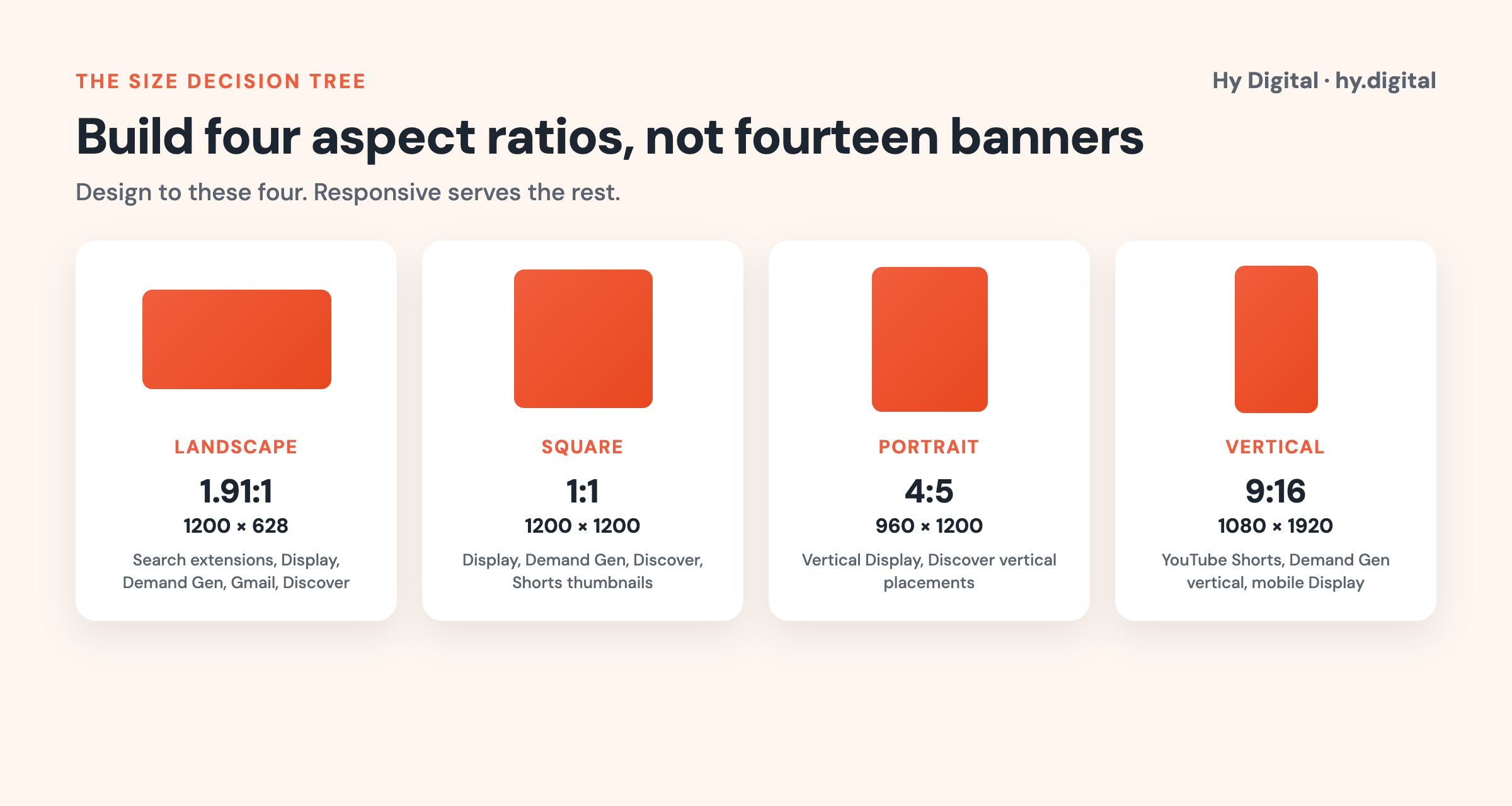
You no longer need to design 14 banner sizes. Build to four aspect ratios and let responsive serve the rest.
| Master file | Aspect | Pixels | Covers |
|---|---|---|---|
| Landscape | 1.91:1 | 1200 × 628 | Search image extensions, Display, Demand Gen, Gmail, Discover |
| Square | 1:1 | 1200 × 1200 | Display, Demand Gen, Discover, YouTube Shorts thumbnails |
| Portrait | 4:5 | 960 × 1200 | Vertical Display, Discover vertical placements |
| Vertical video | 9:16 | 1080 × 1920 | YouTube Shorts, Demand Gen vertical, mobile-first Display |
Plus, for video:
If you want fallback fixed-size banners for the residual Display network, build the top three: 300×250, 728×90, 320×100.
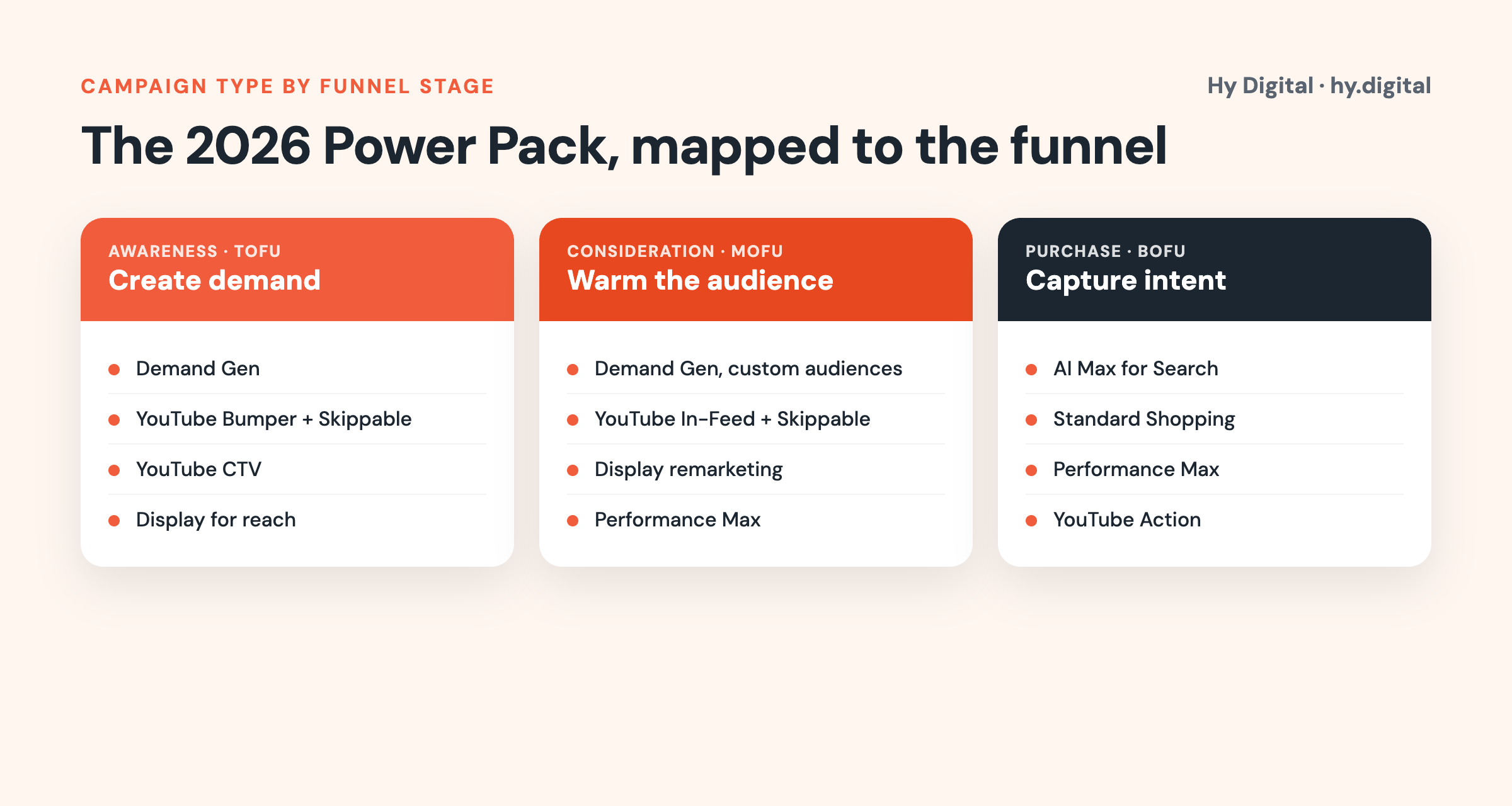
The Power Pack maps cleanly onto the awareness, consideration, purchase funnel.
| Campaign | Why it works at TOFU |
|---|---|
| Demand Gen | Visual-first across YouTube, Gmail, Discover, Maps. The Google equivalent of "build the audience before you sell to them". |
| YouTube Bumper + Skippable In-Stream | Brand-recall format. Cheap CPM, scale reach. |
| YouTube CTV | The highest-completion-rate inventory Google sells. Higher CPM but premium environment. |
| Display (RDA) for prospecting | Cheap reach. Use it for retargeting more than prospecting in most accounts. |
Avoid at TOFU: AI Max for Search (no cold demand to capture) and Performance Max with weak audience signals (the algorithm will spend most of the budget on cheap-but-irrelevant clicks).
| Campaign | Why it works at MOFU |
|---|---|
| Demand Gen with custom audiences | Retarget Demand Gen TOFU viewers with deeper consideration content. |
| YouTube In-Feed and Skippable In-Stream | Mid-funnel demos, testimonials, "how it works" 60 to 90 second videos. |
| Display Remarketing | Cheapest way to keep your brand visible to page-viewers. |
| Performance Max (with audience signals) | Starts to earn its keep here once the algorithm has audience hints to learn from. |
| Campaign | Why it works at BOFU |
|---|---|
| AI Max for Search | Pure intent capture. The most reliable BOFU surface on the internet. |
| Standard Shopping | E-commerce; high-intent search plus product-level visibility. |
| Performance Max | When the algorithm has enough conversion data, PMax becomes a closer. |
| YouTube Action / In-Stream with direct-response CTAs | YouTube can convert if you give it a clear offer and a frictionless landing page. |
Google's own recommendation for 2026, validated across multiple agency benchmark sets.
E-commerce:
B2B, services, and lead-gen:
Add to that, where relevant: Standard Shopping running in parallel for margin protection, Display retargeting for branded reach, and YouTube CTV for premium awareness in select verticals.
The thing to internalise. PMax is not the entire account. Running PMax alone in 2026 is a tactic, not a strategy. The accounts that win run the Power Pack in concert.
Google's AI works better with diverse seed material. Mix these headline types:
Provide 12 to 15 headlines with this mix. Pin sparingly. Google's AI rewrites better when it's not over-pinned.
Build in 9:16 and 16:9 versions. Square (1:1) optional, but adds incremental reach.
The single biggest PMax mistake is dumping all assets into one asset group. The correct approach:
Themed asset groups give the algorithm cleaner signal and let you read performance per theme.
Six seconds is unforgiving. The pattern that works:
If your ad agency brings you a 6-second bumper with three scene cuts, send it back.
PMax, Demand Gen, and AI Max are all AI-driven. AI is only as good as the conversion data feeding it. The accounts that win in 2026 share these traits:
Tracking isn't optional any more. PMax with bad tracking spends the same money less effectively, and you have no way to diagnose why.
If you are starting a Google account from scratch in 2026, here's the structure with the highest probability of working.
E-commerce starter pack (4 campaigns):
B2B and services starter pack (3 campaigns):
Add YouTube CTV if your product justifies the CPM (luxury, B2B with long sales cycles, regulated industries where brand trust drives conversion).
| Stage | Job | Campaign | Surface | Primary asset |
|---|---|---|---|---|
| TOFU | Reach + signal | Demand Gen | YouTube + Gmail + Discover | 9:16 video |
| TOFU | Brand recall | YouTube Bumper | YouTube | 6s video |
| TOFU | Premium reach | YouTube CTV | Connected TV | 30s video |
| TOFU | Cheap fill | Display (RDA) | GDN | Multi-aspect images |
| MOFU | Demo + educate | YouTube Skippable | YouTube | 30 to 90s video |
| MOFU | Retarget | Display Remarketing | GDN | Multi-aspect images |
| MOFU | Warm-up | Performance Max | All Google | All assets |
| BOFU | Intent capture | AI Max for Search | Search | Text |
| BOFU | Product surface | Shopping (Standard or PMax) | Search + Shopping | Product feed |
| BOFU | Convert | Performance Max | All Google | All assets |
This document is correct as of May 2026. The Google surfaces most likely to change in the next 12 months:
We refresh this doc whenever a material spec or default changes. If the date at the top is more than 90 days old, ask whoever briefed you to update it.
Four aspect ratios cover the network: 1.91:1 (1200 x 628), 1:1 (1200 x 1200), 4:5 (960 x 1200), and 9:16 (1080 x 1920) for vertical video. Responsive formats generate the rest. Building fourteen fixed banner sizes is no longer necessary.
No. Performance Max works best as one part of an account rather than the whole account. Pair it with Search for intent capture and Demand Gen for the upper funnel. Running it alone leaves you with little visibility into where growth actually comes from.
AI Max for Search is Google's AI-driven search campaign type. It sits at the bottom of the funnel and captures existing intent. It belongs alongside Performance Max rather than replacing it.
Demand Gen and YouTube carry the awareness stage, including Bumper, skippable in-stream, and Connected TV. Search and Shopping are better kept for the intent-capture stage further down the funnel.
For full-funnel coverage, yes. YouTube and Demand Gen both depend on video, and a 9:16 vertical asset covers Shorts and mobile placements. You can start with Search and Shopping without video, though upper-funnel reach will be limited.
Every Meta and Instagram ad format that serves in 2026, with exact sizes, safe zones, and what converts at each funnel stage.
Unlock the full potential of your digital marketing strategy by understanding the unique benefits and synergistic power of Google and Facebook Ads.
Google Ads and GA4 measure conversions differently. A reconciliation playbook from Hy Digital for marketing teams in Southeast Asia.
Be the first to know about new B2B SaaS Marketing insights to build or refine your marketing function with the tools and knowledge of today’s industry.
