Google ad formats in 2026
The full Google Ads stack in 2026: Performance Max, AI Max for Search, Demand Gen, YouTube CTV. Sizes, funnel mapping, and the Power Pack budget...
Every Meta and Instagram ad format that serves in 2026, with exact sizes, safe zones, and what converts at each funnel stage.
If you only read the first 200 words:
Now the version you actually run campaigns from.
A few structural shifts have changed what "good" looks like on Meta.
Roughly 90% of Meta's ad inventory is now vertical. About 98% of usage is on mobile. Square and landscape still serve, but they are the minority placements, not the majority. (Source: AdMove)
The standalone Instagram Explore feed was retired in January 2026. That traffic now flows into Reels. (Source: Superscale)
In March 2026, Meta consolidated the safe zones across Facebook Stories, Facebook Reels, Instagram Stories, and Instagram Reels into one set: top 14% reserved for the profile and "Sponsored" label, bottom 35% reserved for CTA and captions, leaving the centre 51% as the useable area. (Source: Superscale)
Advantage+ is the default in 2026. Manually configured campaigns deliver around 32% higher CPA than Advantage+ on equivalent setups in published benchmarks. (Source: OptiFOX)
Collection moved. As of March 2026, Collection no longer appears in Ad setup. You select it under Ad creative, Format display options. (Source: AdManage)
If your agency is still building 1:1 hero images, running a five-ad-set "interest test", and shipping landscape video to Stories, you are paying a tax to be three years behind the platform. I keep seeing this in account audits.
Meta groups its surfaces into placements, and creative gets matched to placements through the asset customisation rules. The formats below are the building blocks every brief should start from.
The largest single placement on Meta in 2026 and the cheapest at the top of the funnel.
On performance: Reels often delivers lower CPC than Feed and higher engagement, though the exact gap varies a lot by industry and creative quality. Treat published "26% cheaper than Feed" figures as directional, not promised. (Source: AdAmigo benchmarks)
Use Reels when you need reach, top-of-funnel learning data, or you want to test creative angles cheaply.
The original placement, still the highest-intent surface for many B2B and lead-gen accounts.
The default aspect ratio in 2026 is 4:5 portrait (1080 × 1350 px). Feed also serves 1:1 (1080 × 1080) and 1.91:1 (1200 × 628), but 4:5 occupies roughly 20% more vertical screen on mobile and is the recommended default.
Video length goes up to 240 minutes technically, but performance lives in the 5 to 30 second band for cold audiences. Longer formats work for warm and bottom-funnel. Images: 1080 px on the long edge, JPG or PNG, under 30 MB.
Use Feed when you have a clear hook that reads in a half-second scroll, a strong static, or a high-context message that needs more dwell time.
Two to ten swipeable cards, all locked to the same aspect ratio.
Recommended ratio is 1:1 (1080 × 1080) so cards survive every placement. 4:5 also works but reduces placement coverage. Cards: 2 minimum, 10 maximum. Images and videos can mix inside one carousel as long as the aspect ratio stays consistent.
What carousel is good for in 2026: step-by-step explainers ("how the service works", "before and after"), multi-product showcases when Collection isn't an option (lead-gen, services), and retargeting where multiple proof points beat a single message. Published benchmarks put carousel retargeting at roughly 30 to 50% lower cost-per-conversion than single-image retargeting. Treat as directional. (Source: OptiFOX)
A hero image or video sitting above a scrollable grid of product images. Tapping the hero opens an Instant Experience, which loads inside the app and is noticeably faster than a typical mobile landing page. Reported benchmarks suggest Instant Experiences load up to 15× faster than standard mobile sites. (Source: Confect)
Collection ads paired with a product catalogue have shown noticeably higher click-through and ROAS than single-image equivalents in Meta's own case studies. Treat as directional and verify against your own pixel data. (Source: AdNabu)
Use it when you have a product catalogue, you're running Advantage+ Sales, and your audience is on mobile.
Stories now sits in the same vertical inventory and safe-zone pool as Reels.
Stories has become a way to add inventory volume to Reels-style creative rather than a standalone format you build for. Build one 9:16 master, let Meta serve both.
A native form that opens inside Facebook or Instagram. The form is pre-filled with the user's Meta profile data, which is what makes the CPL so low.
CPL impact: typically 40 to 70% lower than landing-page lead campaigns. (Source: AdAmigo benchmarks)
The quality trade-off matters: Instant Forms win on CPL. Landing pages win on cost-per-qualified-opportunity in most B2B verticals, because friction filters. Best practice in 2026 is to run both. Instant Form generates volume and warm audiences. Retarget those people with a landing-page conversion campaign for the qualified follow-up.
Personalised ads that pull from your product feed and serve product-level retargeting and prospecting at scale. This is not a creative you build. It's a campaign type that uses your catalogue plus a few creative templates.
Use it when you have a real catalogue with 30+ SKUs and the pixel is properly wired. Wired badly, this format fails silently, which is the worst failure mode in advertising.
In-stream video (mid-roll, 16:9, 5 to 15 seconds) is still alive, mostly a Facebook-side placement. Don't build for it. Let asset customisation serve it.
Audience Network (banner, interstitial, in-stream on third-party apps) is an optional placement. Toggle off if quality matters more than reach.
Messenger inbox and Marketplace are niche. Default to letting Advantage+ Placements pick.
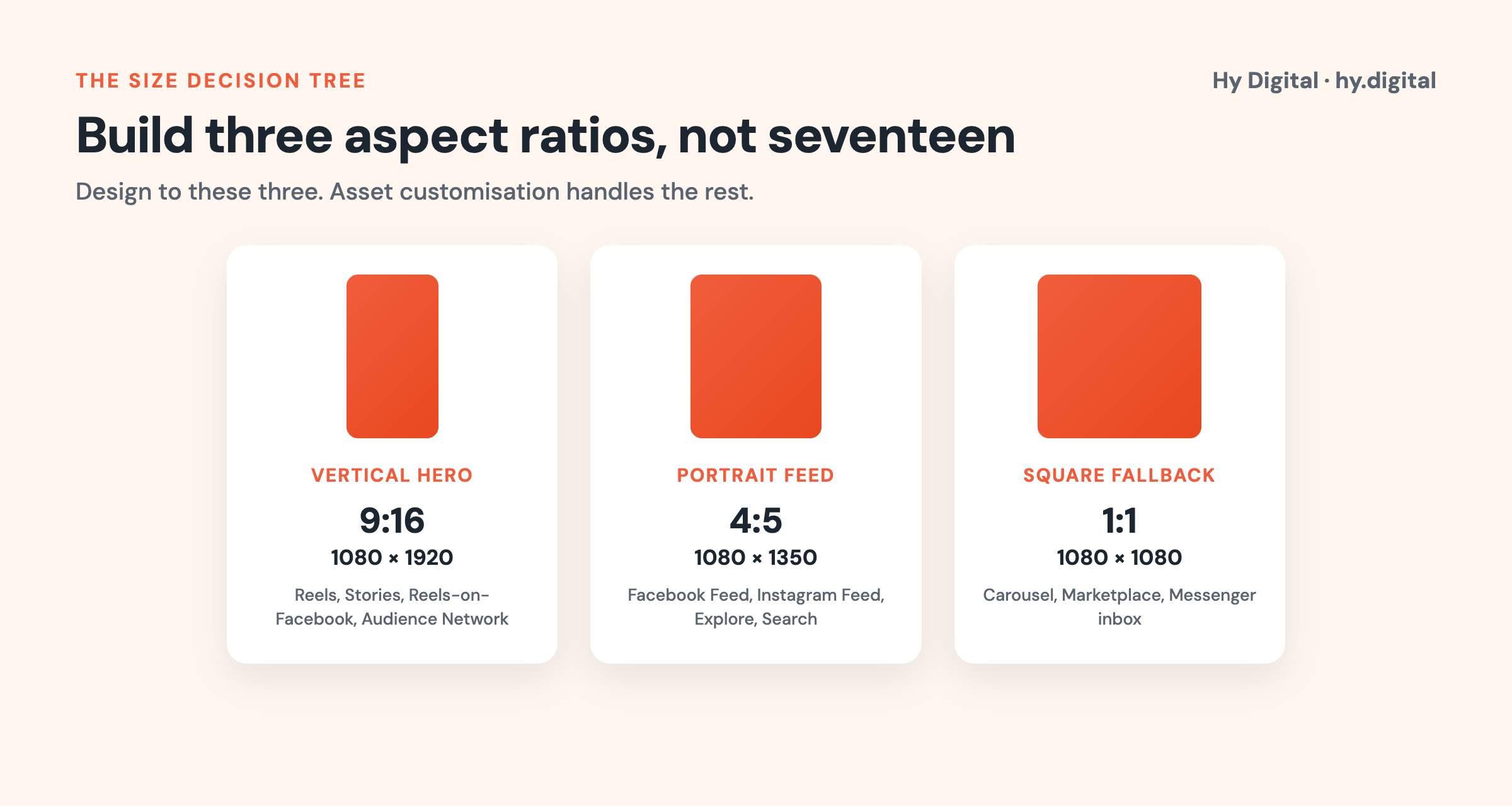
Forget memorising 17 aspect ratios. Build to three.
| Master file | Aspect | Pixels | Covers |
|---|---|---|---|
| Vertical hero | 9:16 | 1080 × 1920 | Reels, Stories, Reels-on-Facebook, Audience Network rewarded video |
| Portrait feed | 4:5 | 1080 × 1350 | Facebook Feed, Instagram Feed, Explore, Search |
| Square fallback | 1:1 | 1080 × 1080 | Carousel, Marketplace, Messenger inbox |
That's it. Asset customisation handles the rest. Spending design time on 1.91:1 hero variants is 2022 thinking. The inventory has moved.
Hard don'ts:
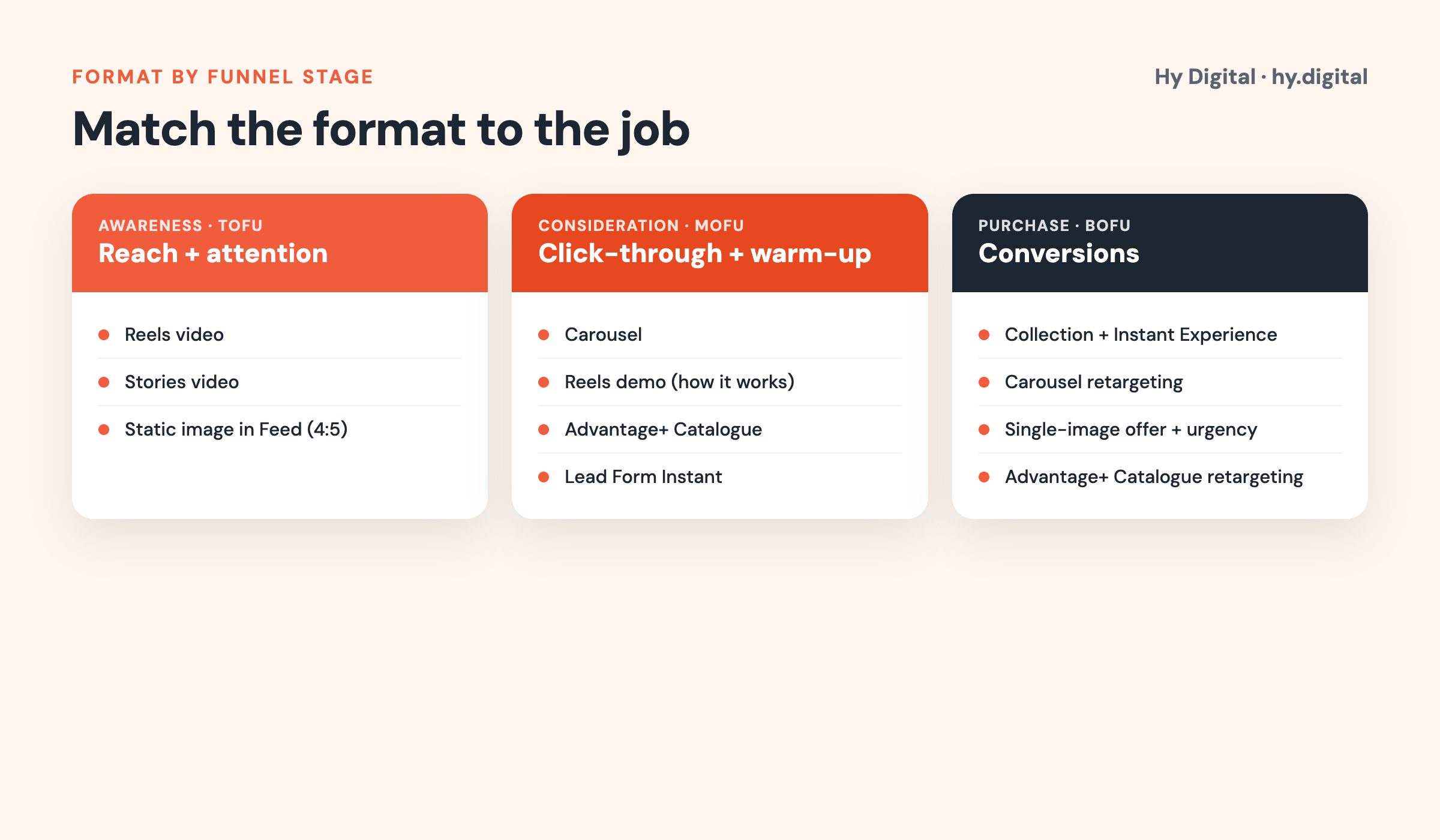
The honest answer is "it depends on your category and offer." That said, the pattern below holds across most published 2026 benchmark sets.
| Format | Why it works at TOFU |
|---|---|
| Reels video | Cheapest CPM in 2026, highest engagement, native to how people scroll. The best top-of-funnel format. |
| Stories video | Same inventory pool as Reels. Add for incremental reach, don't build separately. |
| Static image in Feed (4:5) | Cheap to produce, good for testing message-market fit before investing in video. |
Avoid at TOFU: Collection (mobile shopping experience wasted on a cold audience), Lead Form (the audience hasn't earned the ask yet), and long-form Feed video over 30 seconds.
| Format | Why it works at MOFU |
|---|---|
| Carousel | Lets you show the offer from multiple angles. Strong on retargeting against page-viewers and engagers. |
| Reels mid-funnel ("here's how it works") | Demo-style 30 to 45 second Reels convert page-viewers into add-to-carts at scale. |
| Advantage+ Catalogue | If you have a catalogue, this is where it earns its keep. Serves the products the viewer hovered on. |
| Lead Form Instant | For service businesses, the cheapest way to capture intent at MOFU. Volume over quality. |
| Format | Why it works at BOFU |
|---|---|
| Collection + Instant Experience | The mobile-storefront experience. Compresses scroll-to-cart into one tap. |
| Carousel retargeting | Highest-converting retargeting format in most published benchmarks. |
| Single-image Feed with offer + urgency | When the audience already knows you, a clean offer with scarcity beats most video. |
| Advantage+ Catalogue retargeting | The "you forgot something in your cart" format. Essential for e-commerce. |
A caveat. At BOFU, format matters less than creative diversity. Meta's Advantage+ algorithm wants 15 to 50 active creatives to find the winner. A single perfect ad isn't the right shape of bet any more. (Source: AdMove)
Tested against thousands of ads in 2026 benchmark studies:
Native-style production (handheld, lo-fi editing, natural lighting) consistently outperforms polished studio production for Reels in 2026 benchmark sets. (Source: Digital Applied)
The single biggest 2026 shift is creative volume. Meta's algorithm penalises low-volume campaigns because it cannot find the winning variant.
| Creative count | What Meta does |
|---|---|
| 1 to 3 active ads | Algorithm forced to over-deliver one ad. Learning phase rarely exits. |
| 4 to 14 active ads | Standard 2023 setup. Still works, but underperforms. |
| 15 to 50 active ads | Algorithm-recommended volume for Advantage+. Finds winners faster, less prone to fatigue. |
| 50+ | Diminishing returns unless you're a top-100 spender. |
The fix is to produce creative in batches of 5 to 10 per cycle, with genuine angle diversity. A UGC clip. A founder talking head. A product demo. A testimonial. A static lifestyle shot. Five visually identical product photos with different copy is one creative, not five.
In 2026, Advantage+ Placements is the default and the right default for roughly 90% of campaigns. Exceptions where manual placement still pays off:
Otherwise, let Advantage+ Placements pick. Spending a day building placement-specific variants for Marketplace and Messenger is almost never worth the production cost.
If you are starting a Meta account from scratch, here's the structure with the highest probability of working in 2026:
Budget split, as a starting point:
Refine after 14 days based on what your actual pixel and CAPI data says. Don't optimise sooner. Advantage+ needs the learning runway.
A clean reference table for briefs:
| Stage | Job | Format | Aspect | Length | Cost signal |
|---|---|---|---|---|---|
| TOFU | Reach + signal | Reels video | 9:16 | 15 to 30s | Lowest CPM |
| TOFU | Cheap test | Static Feed | 4:5 | n/a | Low CPM, weak CTR |
| MOFU | Educate | Carousel | 1:1 | n/a | Higher CTR than single-image |
| MOFU | Demo | Reels mid | 9:16 | 30 to 45s | Mid CPM, high engagement |
| MOFU | Capture intent | Lead Form | n/a | n/a | Lowest CPL, lower lead quality |
| BOFU | Convert | Collection | 1:1 hero | 8 to 15s | Highest CTR in mobile |
| BOFU | Retarget | Carousel | 1:1 | n/a | Lowest CPA in benchmarks |
| BOFU | Catalogue | Advantage+ Catalogue | auto | n/a | Cheapest BOFU per SKU |
This document is correct as of May 2026. The Meta surfaces most likely to change in the next 12 months:
We refresh this doc whenever a material spec or default changes. If the date at the top is more than 90 days old, ask whoever briefed you to refresh it.
Three. 9:16 (1080 x 1920) for Reels and Stories, 4:5 (1080 x 1350) for Feed, and 1:1 (1080 x 1080) for Carousel and Marketplace. Asset customisation handles the remaining placements.
Reels video. It is native to how people scroll and it is the largest placement on Meta. Stories draw from the same inventory pool, so add them rather than building separately. A static 4:5 image in Feed is a cheap way to test a message before investing in video.
Collection ads, Lead Form ads, and Feed video longer than 30 seconds. Each one asks more of a cold audience than it is ready to give.
It serves products from your catalogue based on what a viewer already engaged with. Use it in the middle and bottom of the funnel, particularly for retargeting people who viewed a product or abandoned a cart.
No. They draw from the same 9:16 inventory. Build once at 1080 x 1920, keep the centre of the frame clear of important text, and use it across both.
The full Google Ads stack in 2026: Performance Max, AI Max for Search, Demand Gen, YouTube CTV. Sizes, funnel mapping, and the Power Pack budget...
Discover the power of retargeting ads for effective customer re-engagement. Turn potential interest into confirmed sales with our latest guide!
Unlock the full potential of your digital marketing strategy by understanding the unique benefits and synergistic power of Google and Facebook Ads.
Be the first to know about new B2B SaaS Marketing insights to build or refine your marketing function with the tools and knowledge of today’s industry.
