Unlock Success with Strong Engagement Strategy | Hy Digital
Maximize your marketing by engaging your audience, delivering valuable content, and tracking KPIs to strengthen relationships and drive conversions.
AI bidding (Performance Max, Meta Advantage+) only works when your tracking is right. Here is what good tracking looks like and what we set up before any campaign.
Everyone wants AI to run their campaigns. Google's Performance Max, Meta Advantage+, LinkedIn's automated bidding, they all promise to find the right audience, at the right time, for the right cost. And they can deliver, but only when they have good data to work with.
Here is the part most agencies skip over: the AI does not know anything you have not told it. It learns from your conversion signals. If those signals are incomplete, delayed, or just wrong, the algorithm optimizes toward the wrong thing. You end up with campaigns that look like they are working and a pipeline that tells a different story.
This is not a technology problem. It is a tracking problem.
When you run Google Ads on smart bidding, the algorithm needs conversion data to make decisions. It is asking: which clicks turned into revenue? From that, it figures out which users, placements, and times of day are worth bidding up.
If your conversion tracking is only capturing form fills, but your actual revenue comes from deals that close in HubSpot 30 days later, the algorithm never sees that signal. It optimizes for form fills. You get a lot of leads. Your sales team gets a lot of garbage.
The same applies to Meta. If you are running lead gen campaigns and pixel-only tracking, Meta is working with browser data that Safari and iOS already blocked. A meaningful portion of your conversions are simply invisible to the platform.
The AI is not broken. It is doing exactly what you asked. The problem is what you asked for.
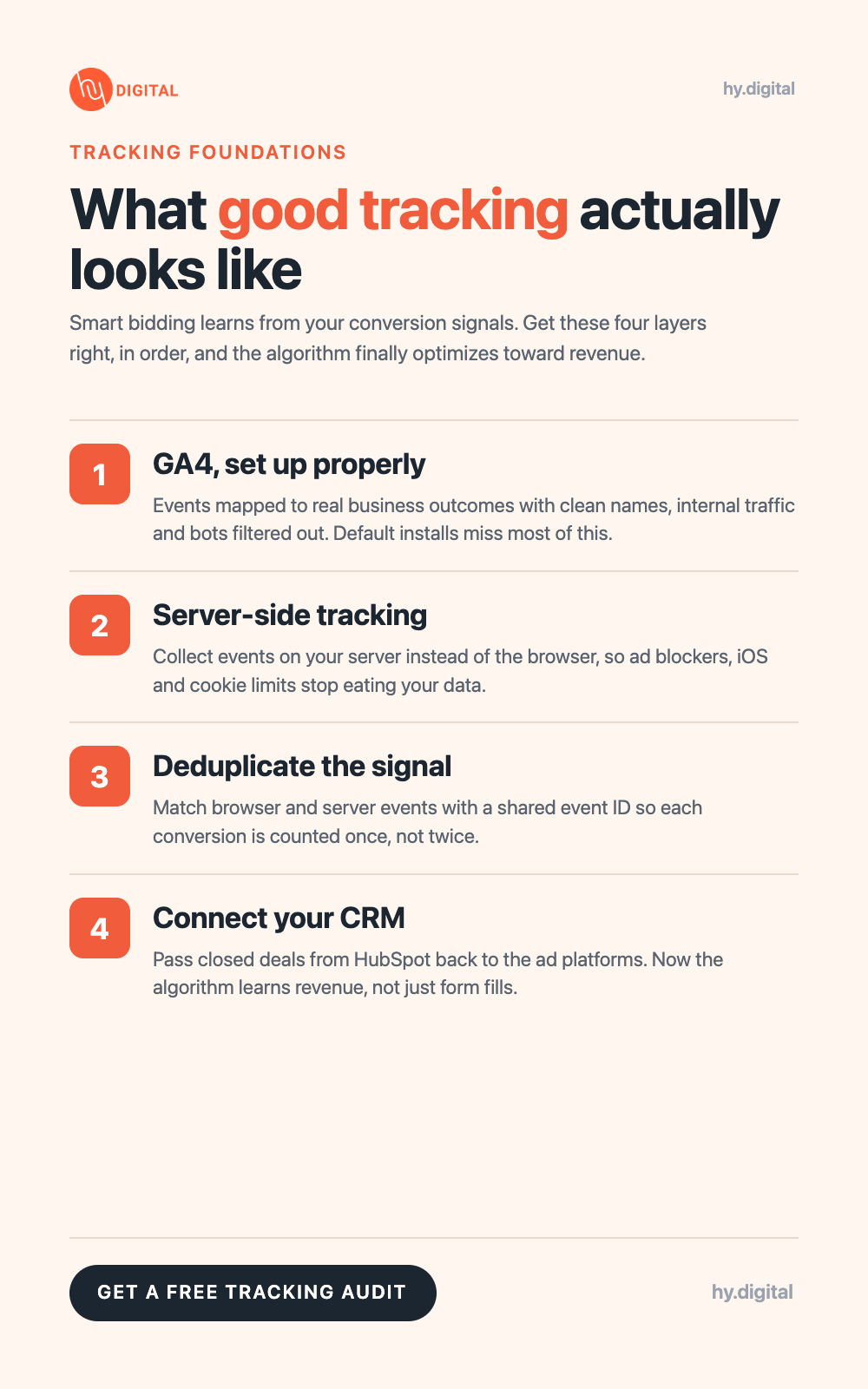
Getting this right has a few layers. They build on each other.
Run a free tracking audit on your site →
GA4 out of the box is not GA4 set up right. Default installs miss a lot.
What you actually need:
GA4 also requires you to think about your data model upfront. If you set it up reactively, adding events as you remember them, you end up with a mess that nobody trusts.
Browser-based tracking is getting less reliable every year. Ad blockers, browser privacy updates, cookie restrictions: these all eat into your data. The gap between what actually happened and what your pixel captured is wider than most marketers realize.
Server-side tracking moves the data collection off the user's browser and onto your server, then sends it directly to GA4, Meta's Conversions API, and Google's Enhanced Conversions. Because it bypasses the browser, it is not affected by blockers or cookie settings.
The result is significantly better data match rates. For Meta campaigns especially, getting server-side events flowing through the Conversions API can recover a meaningful share of conversions that were previously invisible.
This is not a minor technical upgrade. It changes what the algorithm sees, which changes how it bids, which changes your results.
Server-side and browser-side tracking often fire for the same event. If you are not deduplicating, you are counting the same conversion twice. That doubles the signal, which confuses the algorithm and inflates your reported performance.
Deduplication means matching events from both sources using a shared event ID, so the platform counts each conversion once. It requires some setup, but it is non-negotiable if you are running both.
This is where most B2B companies leave serious money on the table.
Platforms like Google and Meta can accept offline conversion data. If you close a deal in HubSpot, you can pass that conversion back to the campaign that generated the original lead. The algorithm then learns which clicks actually become revenue, not just which clicks fill out forms.
In practice, this means building a data flow from HubSpot to your ad platforms: either through native integrations, a custom webhook, or an intermediary like Google's offline conversion import. It takes work to set up. It changes what you are optimizing for entirely.
AI bidding has become significantly more capable. Performance Max, Meta Advantage+, and smart bidding strategies genuinely work, provided the signal quality is there.
The companies getting the best results from these tools are not necessarily spending more. They are feeding better data. Their conversion events are accurate. Their CRM data is flowing back. Their campaigns are optimizing toward revenue, not proxy metrics.
The companies getting poor results are usually not running bad creative or bidding wrong. Their tracking is just broken, and the algorithm is flying blind.
At Hy Digital, tracking is the first thing we fix before we touch any campaign.
For clients running paid media, our standard setup includes GA4 configured correctly with business-relevant events, server-side tracking via Google Tag Manager server container, Meta Conversions API integration with deduplication, and offline conversion imports flowing from HubSpot into Google Ads.
We also run a free tracking audit for businesses that want to understand where their current setup breaks down before committing to anything. It covers your GA4 configuration, conversion signal quality, and whether your ad platforms are seeing the data they need.
If your campaigns are running on smart bidding and your numbers do not feel right, the tracking is usually where to look first.
The AI is only as good as what you give it. Start there.
Want to know where your tracking breaks down? Book a free tracking audit or a 20-minute strategy session: https://hy.digital/meetings/umi/20-min-strategy-session
Maximize your marketing by engaging your audience, delivering valuable content, and tracking KPIs to strengthen relationships and drive conversions.
Enhance your advertising strategy with lookalike audiences. Find out how to build and use lookalike audiences to reach new potential customers who...
Unravel the significance of maintaining consistent pricing between official hotel websites and OTAs, and how it impacts the travel industry.
Be the first to know about new B2B SaaS Marketing insights to build or refine your marketing function with the tools and knowledge of today’s industry.
